

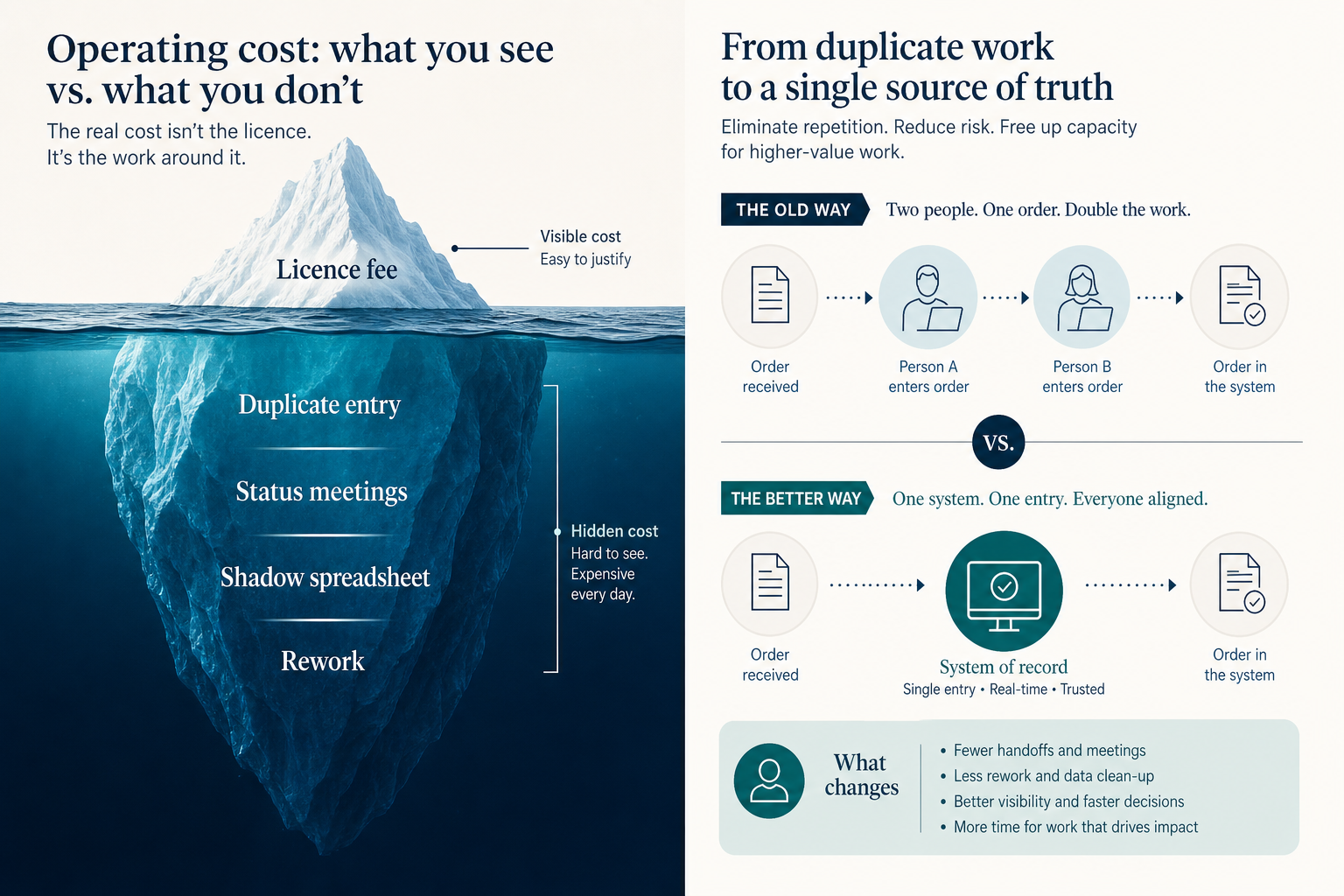
A company can spend on software and still watch costs rise. That happens when technology reports on a process that remains manual: invoices retyped, statuses asked for in chat, stock counted twice. Cost reduction starts by naming the duplicate work.
Where operating cost actually hides
Cost you can see vs cost you keep paying
| Visible cost | Hidden operating cost |
|---|---|
| Licence fees | Two people entering the same order |
| Cloud invoice | Week-end reconciliations because systems disagree |
| Implementation | Managers as human APIs between tools |
| Support tickets | Rework when the “source of truth” was a spreadsheet |
A sequence that reduces cost
- Pick one workflow with volume (orders, invoicing, onboarding, support).
- Write the steps as they happen, including the Excel and chat detours.
- Remove a detour before you add a feature.
- Automate only steps that are already stable and boring.
- Measure cycle time and error corrections — not vanity login counts.
We expand the spreadsheet problem in the hidden cost of manual processes. If the workflow is unique to you, you may be in custom software territory.
Devzin builds and integrates this kind of operational software for teams that have already felt the cost. If you want a partner on that work, see application development.
FAQ
Will software reduce headcount?
Sometimes roles change. Promising a headcount number without measuring the current process is how projects lose trust. Start with cycle time and error rate.
If you need software built around a real workflow — not a stack of disconnected tools — see Devzin application development or start a conversation.